
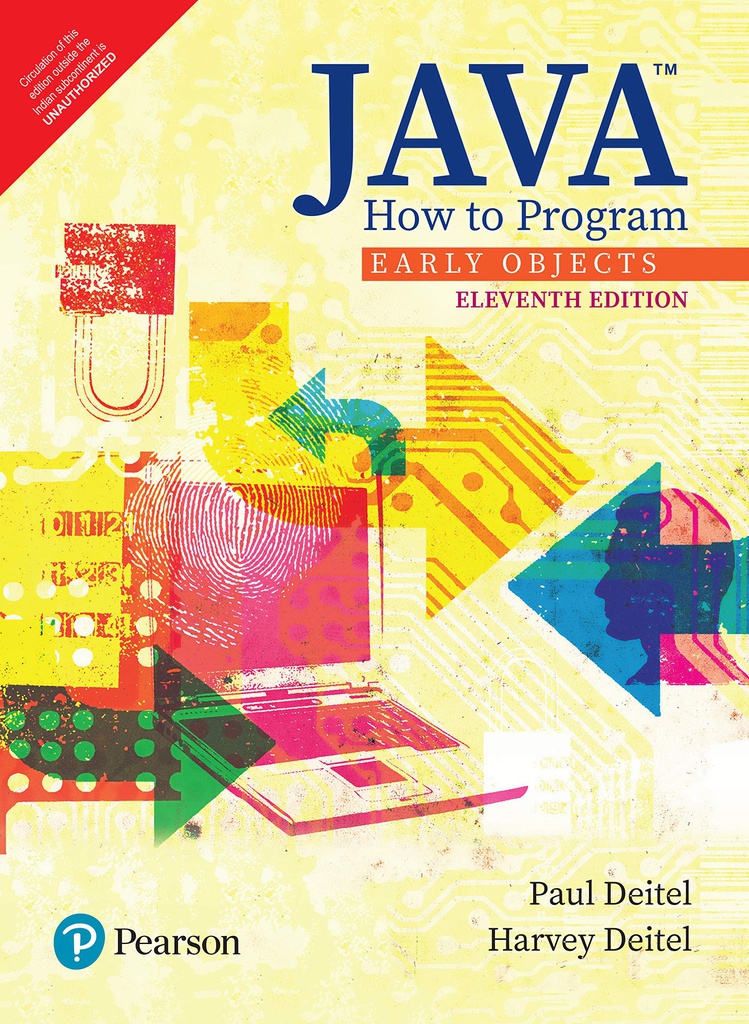
Java How to Program: Early Objects, 11e
Java How to Program, Early Objects, 11th Edition, presents leading-edge computingtechnologies using Deitels’ signature live-code approach, which demonstratesconcepts in hundreds of complete working programs. The ground-breaking How toProgram series offers unparalleled breadth and depth of programming fundamentals,object-oriented programming concepts and intermediate-level topics for furtherstudy. This edition presents Updated coverage of Java SE 8 and New Java SE 9capabilities, including JShell, the Java Module System and other key Java 9 topics.
Features:
Rich coverage of programmingfundamentals; real-world examples:
- Interactive Java through JShell–Java SE 9’s most exciting New pedagogic feature
- Lambdas, sequential and parallel streams, functional interfaces
- JavaFX GUI, 2D and 3D graphics, animation and video
- Composition vs. Inheritance, dynamic composition
- programming to an interface not an implementation
- Files, input/output streams and XML serialization
- Concurrency for optimal multi-core performance
- Other topics: recursion, searching, sorting, generics, data structures, optional Swing GUI, multithreading, database (JDBC TM and JPA
Outstanding applied pedagogy to facilitate learning:
- Programming Wisdom: Hundreds of valuable programming tips facilitate learning. Icons throughout the text identify Software Engineering Observations, Good Programming Practices, Common Programming Errors,Error-Prevention Tips, Portability Tips, Performance Tips and Look-and-Feel Observations (for GUI design).
- Hundreds of self-review exercises with answers.
- Hundreds of interesting real-world exercises and projects enable students to apply what they've learned.
- “Making a Difference” exercises encourage students to use computers and the Internet to research andaddress significant social problems. 1. Introduction to Computers, the Internet and Java 2. Introduction to Java Applications; Input/Output and Operators
Table of Content
1. Introduction to Computers, the Internet and Java
2. Introduction to Java Applications; Input/Output and Operators
3. Introduction to Classes, Objects, Methods and Strings
4. Control Statements: Part 1; Assignment, ++ and -- Operators
5. Control Statements: Part 2; Logical Operators
6. Methods: A Deeper Look
7. Arrays and ArrayLists
8. Classes and Objects: A Deeper Look
9. Object-Oriented Programming: Inheritance
10. Object-Oriented Programming: Polymorphism and Interfaces
11. Exception Handling: A Deeper Look
12. JavaFX Graphical User Interfaces: Part 1
13. JavaFX GUI: Part 2
14. Strings, Characters and Regular Expressions
15. Files, Input/Output Streams, NIO and XML Serialization
16. Generic Collections
17. Lambdas and Streams
18. Recursion
19. Searching, Sorting and Big O
20. Generic Classes and Methods: A Deeper Look
21. Custom Generic Data Structures
22. JavaFX Graphics and Multimedia
23. Concurrency
24. Accessing Databases with JDBC
25. Introduction to JShell: Java 9’s REPL
A. Operator Precedence Chart
B. ASCII Character Set
C. Keywords and Reserved Words
D. Primitive Types
E. Using the Debugger
| Book | |
|---|---|
| Author | Deitel |
| Pages | 1288 |
| Year | 2018 |
| ISBN | 9789353062033 |
| Publisher | Pearson |
| Language | English |
| Uncategorized | |
| Edition | 11/e |
| Weight | 1.52 kg |
| Dimensions | 24.4 x 20.3 x 3.7 cm |
| Binding | Paperback |